

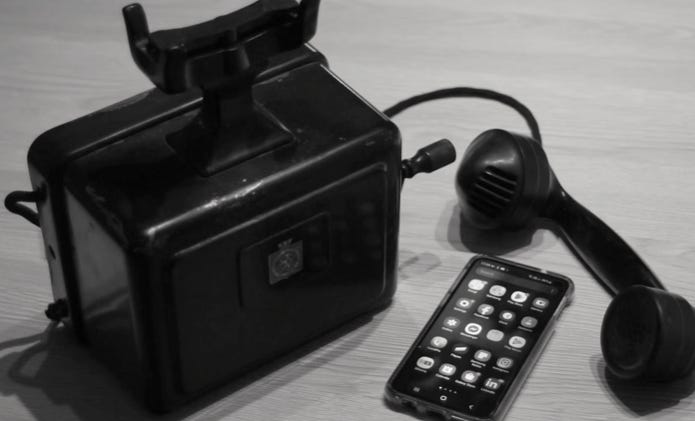
You might be wondering, if you’ve been reading my posts over the past few years, why on earth would a digital (cultural) anthropologist, have an interest in area codes for telephones? Firstly, well, my first “real” job was selling business phone systems and voice mail in 1990 (Yeah, aging myself here.) Which lead me much later into the digital anthropology world and marketing (long story). Secondly, they may well disappear in the near future, making area codes a technological and cultural relic of sorts.
So perhaps this article will survive in some digital format into the centuries and some future anthropologist might surface them on their brain-connected “screen” in their noggin. Or not.
Area codes have come, over the very, very short while that the telephone, historically speaking, has been in existence, to be a sort of ethereal cultural artefact. Although it’s far more likely that a stone tablet from 5,000 years ago will still be around in another 5,000 years. Your smartphone? An old rotary dial phone? Unlikely.
Peculiarly, the Canadian province where I spend most of my time, Nova Scotia, is one of the rare geographical regions that an area code actually occupies and covers the much smaller, yet delightful province, of Prince Edward Island. Its code is 902. It also bounds a culture and all that goes with that. Atlantic Canada, which includes Newfoundland and Labrador is a “tight” culture (as per Michele Gelfand et al), which is conservative with fairly strict social norms, customs and preserved traditions. It is also an incredibly generous culture when it comes to supporting community.
One doubts the engineers at AT&T and Bell Labs who were designing what became the North American Numbering Plan (NANP) in 1947 could’ve imagined we’d run out of phone numbers and have so many devices using them beyond just landline phones (think fax machines). Or that area codes, just part of a system to make switching systems work, would become cultural artefacts.
So the area code 902, has become a cultural symbol as similar as lobsters, lighthouses and Cape Islander fishing boats. For Toronto it’s “The 416” and New York’s famous 212, Beverly Hills, 310 and San Francisco’s 415. Area codes have featured prominently in Hip Hop music, Drake calling out the 416, other rappers using area codes as identity markers and calling out their sense of belonging. I met a fella in Toronto from Nova Scotia that had “902” tattooed on his arm, showing his pride of origin. Cultural symbols and signals.
A further signal of the cultural value we place on area codes was a Seinfeld episode. It turned 212 into a plot point with Elaine scheming to avoid the new 646 code. Some people were selling numbers with 212 for up to thousands of dollars. This is still happening in some areas. Artist Ariana Grande has 561 tattooed on her thumb, a nod to her native Boca Raton. Drake too, has a 416 tattoo. NFL football quarterback Marcus Mariota had 808 on his face mask for Honolulu.
The city of Houston is quite interesting too. Their code is 713 which became so deeply embedded, ingrained, in the city’s hip hop lexicon that July 13th is now celebrated as “713 Day”.
As Caller ID became available on later touch-tone phones, the dynamic of the area code became more socially and culturally important. Just sat down for dinner and the phone would ring? You’d see a toll-free, 1–800 number and yep, telemarketers and the family would sit and wait for the call to go to voice mail. Or you’d see an area code from another part of the country and if no name was attached you figured it was perhaps, a relative. This still happens somewhat with Caller ID on our smartphones. For a while, most telephone companies charged an added fee from $2 to $5 for CallerID. Now it’s just baked in. Not even considered a “feature”.
But is the area code about to become a cultural relic? Might Ariana Grande’s or Drakes grandkids wonder at the 561 tattoo on her thumb and be amused when she has to explain what an area code was? How many of my readers remember how to use a rotary dial phone? Or remember party lines? Listening in on those in rural communities was Saturday night entertainment into the 80s.
Do you know your IP address for your laptop or home router? It’s still needed sometimes, but less and less. And as scammers and marketers buy area codes to appear local, area codes take on a slightly sinister look now too.
It’s entirely possible that some rather clever boffins will invent a whole new numbering system that replaces phone numbers entirely and area codes will slip further into the murky waters of great-grandparent tales. It’s still a bit clumsy exchanging phone numbers with people on our “smart” phones. There are ways that are easier but no one has yet come up with a universal standard, or if they have, brand competition quells it.
For now, the area code carries meaning for people, a social and cultural signal of place-making and meaning-making. But perhaps the area codes days, are, well, numbered? A cultural symbol, what we call semiotics in anthropology, destined to become a relic of a time gone by, a nostalgic nod like the 45 rpm records, the 8-track and the cassette deck. Only those will likely survive longer and are physical artefacts, rather than fading digits.